
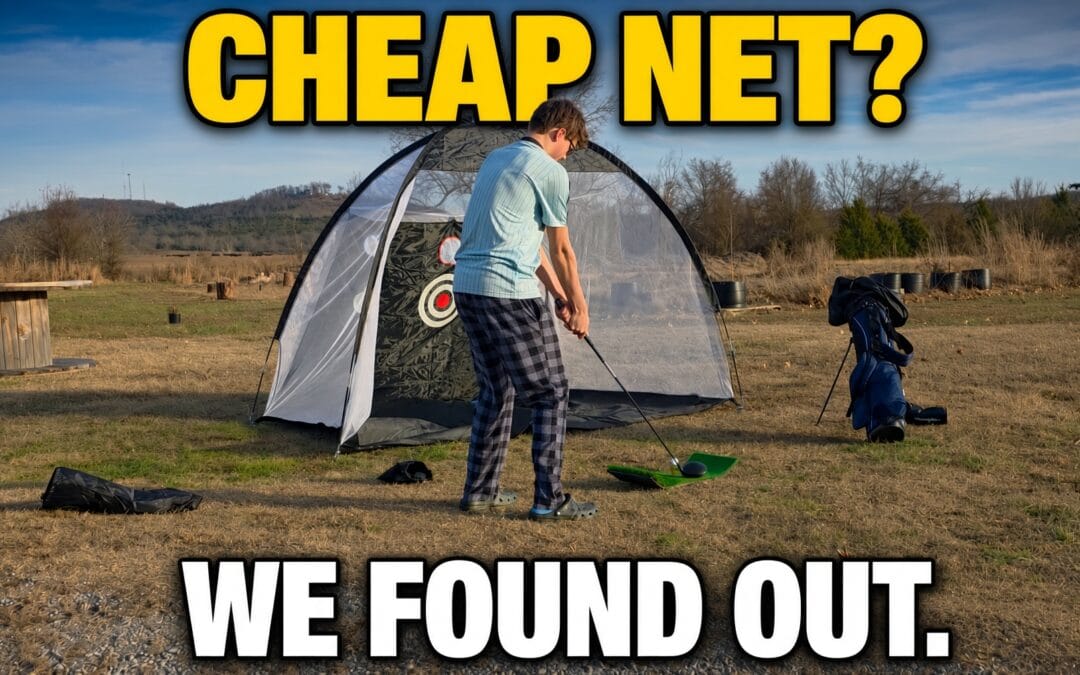
Range fees add up. Winter and a muddy shoulder season shut the course down. And if you live off a back road, “just run to the range after work” is a 40-minute round trip. That is the whole pitch of a backyard hitting net: get swings in without leaving the property.
We pulled this pop-up golf practice net out of the bag, stood it up in an open field, and put a real driver on a real ball. The question that matters is not whether it looks like a driving range in a catalog photo. It is whether the net survives a committed swing — and whether setup is fast enough that you will actually use it on a Tuesday evening.
Product: Pop-up golf practice net with target
What you’re looking at
This is a portable, pop-up hitting tent — black-and-white frame with mesh side panels, a dark impact face, and a high-contrast bullseye plus smaller aiming circles. It comes with a compact turf hitting mat and a black carry bag. In our photos you can see the whole kit in a real yard: net, mat, bag on the ground, clubs standing off to the side.
The design is the same family as the popular backyard “practice tent” nets: a fiberglass-pole skeleton, Oxford-style fabric on the impact wall, and mesh on the sides so wind can pass through instead of turning the net into a sail. That last part matters if you set it up in an open field instead of a sheltered garage.
Setup: fast enough that you’ll use it
This is the part most cheap nets get wrong. If it takes 25 minutes and a printed diagram, it lives in the shed. Ours did not.
Out of the bag, the net pops into shape the way a spring-frame laundry hamper does — unfold, let the frame expand, square the base, drop the mat in front. We were ready to hit in a couple of minutes. No tools. No hunting for missing pole sections. The carry bag on the ground in our photos is the same one it packed into.
That matches what a lot of buyers say about this style of net. Reviews on similar pop-up hitting tents keep repeating the same two sentences: “up in minutes” and “easy to put away.” The nets that stay in the rotation are the ones you can have standing before the coffee gets cold.
A practical note from our session: stake it if the field is windy. The mesh sides help, but a pop-up frame is still light. The kit typically includes ground stakes for that reason. On a calm afternoon we did not need them. On a gusty ridge you will.
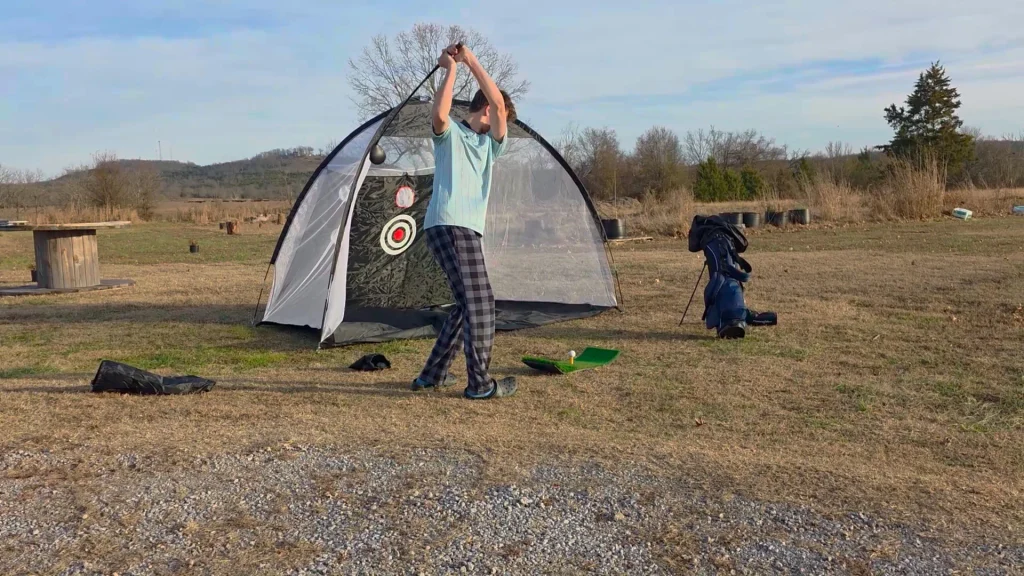
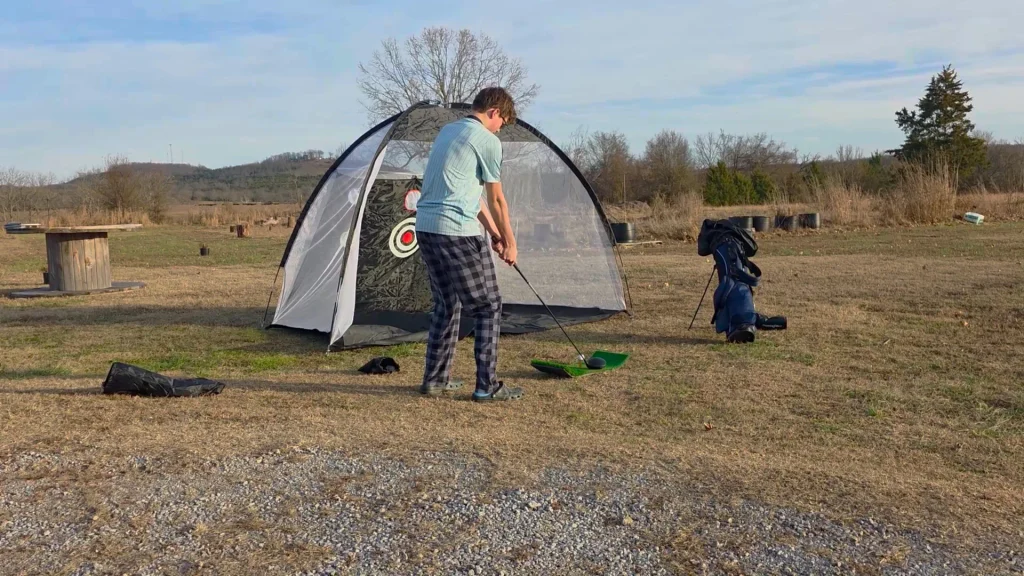
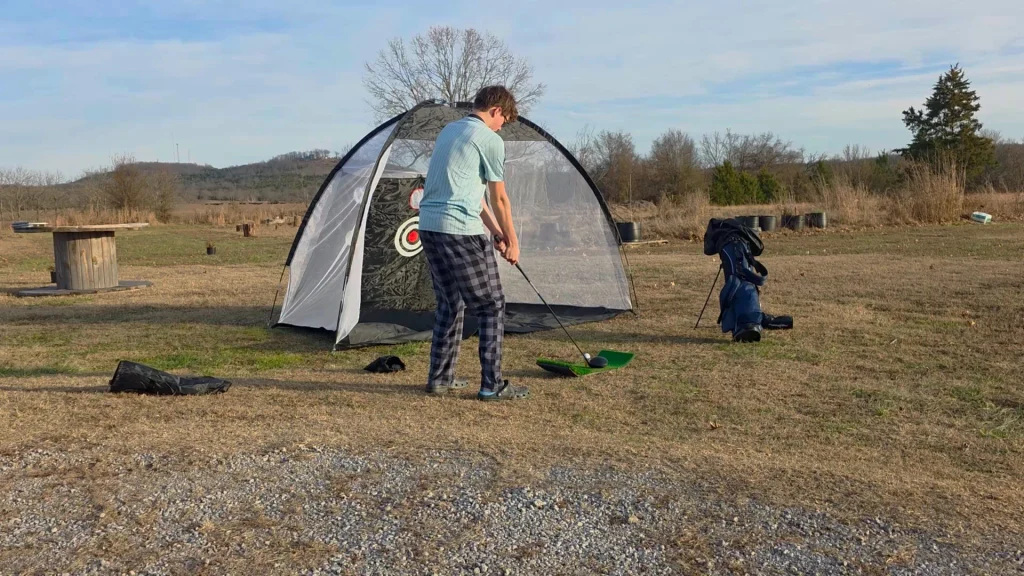
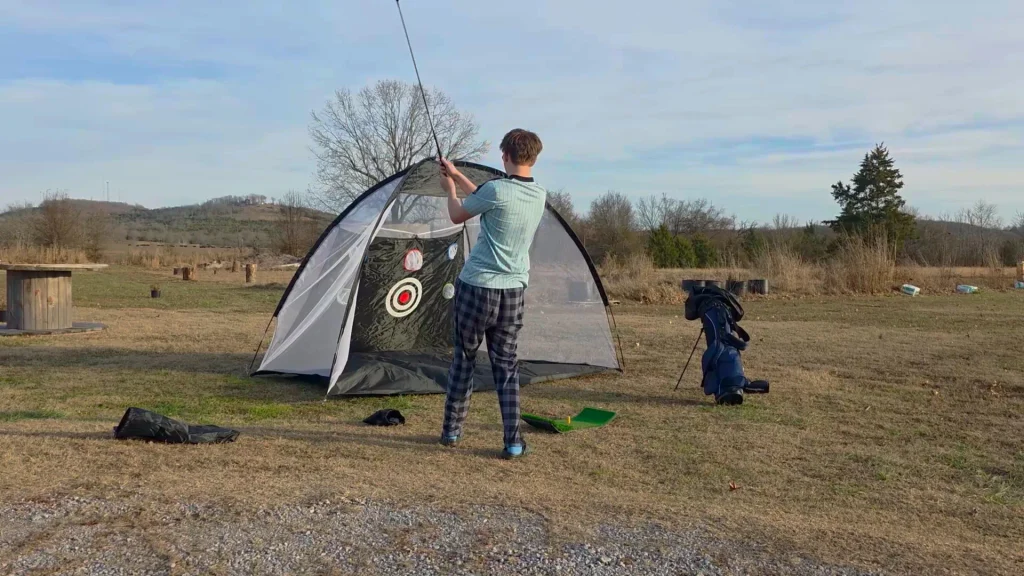
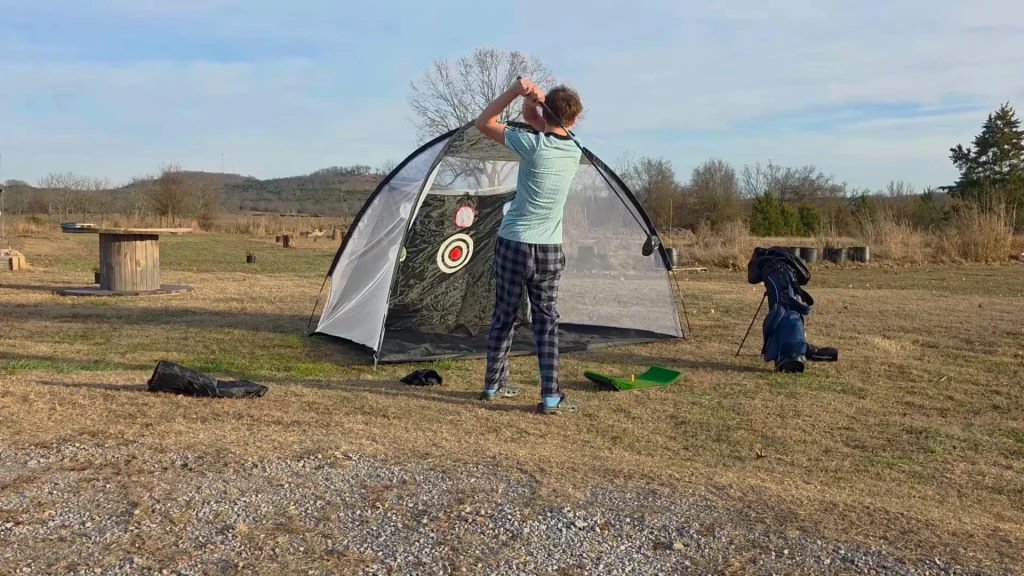
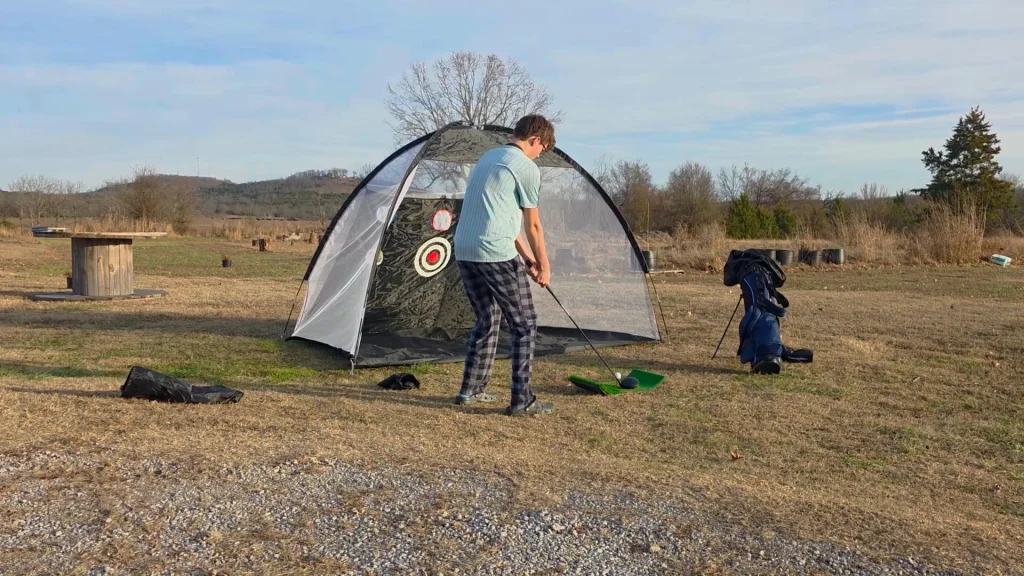
The test that matters: driver into the net
A lot of backyard nets are honest about chips and 7-irons and quiet about the driver. We were not. We teed a real ball on the included mat and swung.
The ball went into the target face. The net ballooned, dumped the energy, and the ball dropped instead of punching a hole or rocketing back at the hitter. No tear in the impact cloth. No collapsed pole. No “that was a one-time miracle” feeling on the next swing.
That is the bar. If a net cannot take a driver, it is a chipping toy with marketing copy.
Other owners of this category of net say the same thing when the build is decent: the target cloth is doing the real work. It spreads the hit so the mesh behind it does not take a pinpoint punch. Cheap nets fail when that cloth is thin, the stitching pops at the corners, or a fiberglass pole splinters after a few weeks of full swings.
Ours looked and felt well-made in the hand — tighter stitching on the target panel, a frame that did not wobble when the ball arrived, and mesh that stayed taut instead of going baggy. After the driver session we walked up and checked the face. Clean.
What other buyers keep saying
We do not pretend one afternoon is a two-year torture test. So we also read through buyer feedback on this style of pop-up hitting net — the 8×6 to 10×7 tent nets with a bullseye and a carry bag. The pattern is consistent.
Praise that shows up again and again:
- Setup really is short. People mention 5–10 minutes the first time, faster after that.
- Good enough size for a full swing without feeling like you have to aim at a postage stamp.
- The target gives you something to aim at, which makes practice less mindless than “hit the green wall.”
- Value. Most of these kits cost a lot less than a season of range buckets.
The complaints to take seriously:
- Wind. Light pop-up frames walk if you skip the stakes.
- The included hitting mat is small. Plenty of reviewers buy a bigger mat later, and we would too if this stays in daily rotation.
- Durability is the split. Well-made units take months of real balls. Bargain units tear at the target corners or snap a pole. Inspect stitching and pole thickness when yours arrives.
- Folding it back into the bag is the only fiddly step. Pop-up frames fight you the first two times. After that it clicks.
Build quality, up close
“Well-made” is a cheap phrase until you look at the parts that fail first.
The impact wall is the heavy panel with the bullseye. That is what a driver hits. Ours had a dense face and the printed target sat flat instead of sagging. The side panels are mesh, which is the right call outdoors — they catch a miss without turning the whole tent into a kite. The frame is the usual fiberglass pop-up skeleton: light enough to carry across a yard, stiff enough that a centered drive did not fold it.
We also liked the small details that show someone thought about real use: a carry bag you can actually get the net back into, a mat that stays put for a session, and a target you can see from address. None of that is fancy. All of it is the difference between gear you use and gear you trip over.
Who this net is for
If you have a strip of yard, a field edge, or a quiet corner of the property and you want more swings than the range schedule allows, this pop-up golf practice net is the right category of product. It is especially useful if:
- You want driver and iron work at home, not just chips into a laundry basket.
- You need something that goes up and comes down the same afternoon.
- You would rather spend money once than keep buying range tokens.
- You have enough clearance in front of the net for a full swing and a miss that goes a little left or right.
It is not a $500 steel cage, and it is not a garage simulator bay. If you plan to leave a net up all year and pound 200 balls a day, step up to a heavier frame. If you want a net you can carry to the side yard, hit for 30 minutes, and put away before supper, this is the job.
How we’d use it
Keep the mat a comfortable wedge in front of the mouth of the net so a thin shot still finds the face. Aim at the bullseye for irons; use the smaller circles when you want a tighter target. Mix in driver last, after the frame is settled and staked. Pick up the balls that drop at the base rather than fishing them out of the back panel.
And give yourself a backstop of open ground behind the net the first few sessions. Even a good net is not a promise that every shank stays home.
The Backroad verdict
Setup was easy and fast. The net is well-made for the price class. And yes — you can drive a real ball into it without punching a hole in the thing. That is the review, in one sentence.
We would buy this again for a rural yard where the nearest range is a chore and a half-hour of swings after chores is the difference between staying sharp and going into Saturday cold. Pair it with a better mat if you get serious. Stake it when the wind comes up. Fold it the way the bag wants you to fold it.
If that sounds like your place, this pop-up golf hitting net earns a spot by the gravel drive.
Check the current listing and price: amzn.to/4xfDBS7
Quick scorecard
| Setup | Easy and fast. Pop-up frame, no tools. |
| Driver test | Took a real drive without damage. |
| Build | Well-made target face, mesh sides, usable bag. |
| Mat | Fine to start. Upgrade later if you grind. |
| Best for | Yard / field practice when the range is a haul. |
| Watch-outs | Stake it in wind. Learn the fold-down. |
Backroad Reviews tests gear the way we actually live with it — in the yard, on the gravel, and in weather that does not wait for a product photo. If it only works on a showroom floor, it does not make the page.
As an Amazon Associate, we earn from qualifying purchases.